The best resort is not always the most expensive one. It is the one that fits your family, access point, intended use and long-term ownership plan.
The Italian Alps are not one market. A family travelling from London every school holiday may need a different base from a buyer splitting time between Geneva and Milan, or an American family looking for a Dolomites home that works in summer as well as winter.
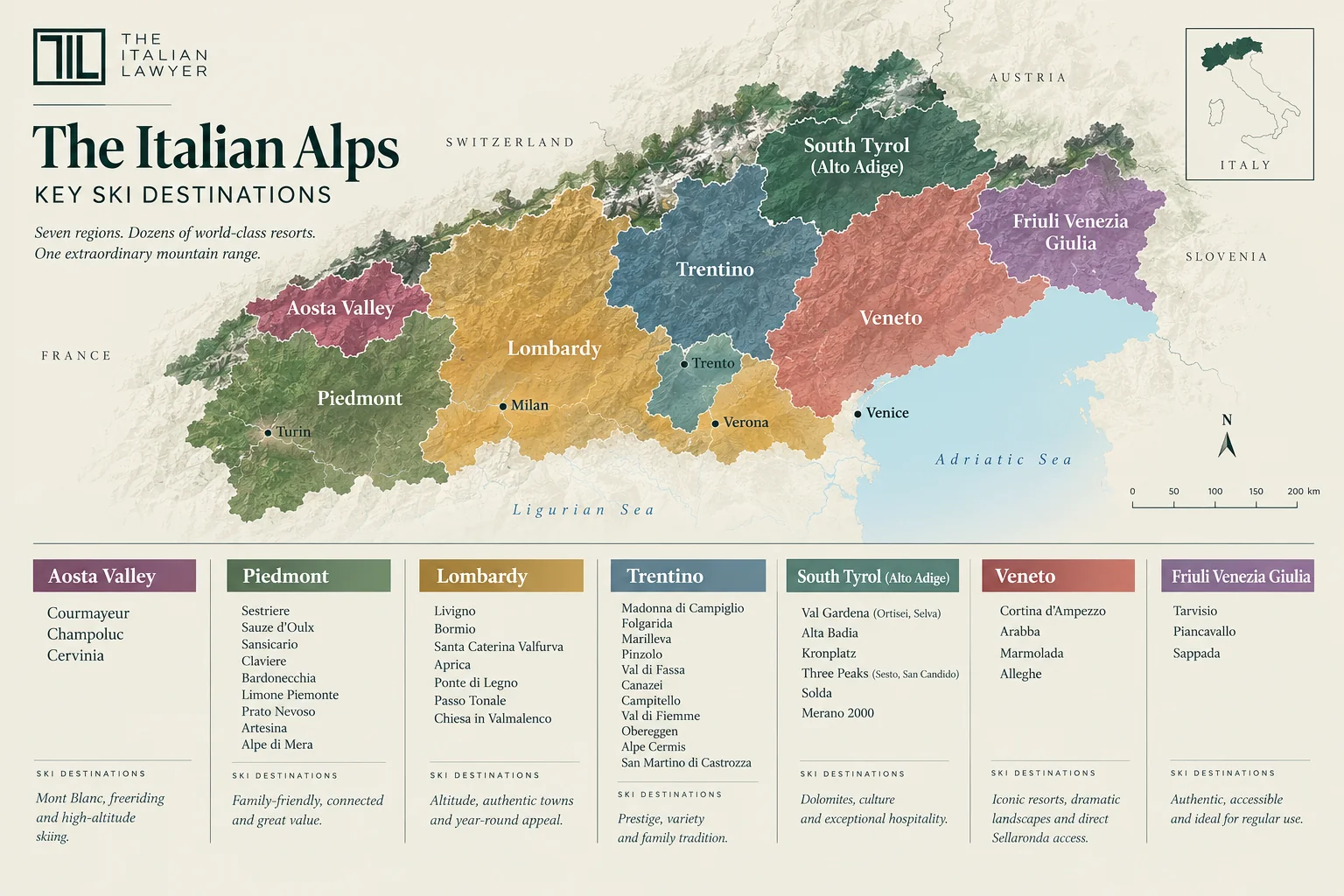
The destinations below reflect the locations international buyers are actively discussing with our team. The purpose is not to rank them. It is to show how the right buying decision changes from one region to another.
Courmayeur remains one of Italy’s most recognisable Alpine addresses. It is a natural fit for buyers who want Mont Blanc, access through Geneva and a resort with an established international character.
Our clients also increasingly ask about Champoluc, particularly where the brief is more understated: serious skiing, freeriding access, space and a family base that feels less performative than a global luxury resort. Cervinia is regularly considered by buyers who value altitude, snow reliability and access to the Matterhorn area.
The legal distinction matters. A privately used chalet in Champoluc has a different risk profile from an apartment in Courmayeur bought with holiday letting in mind. Valle d’Aosta regulates tourist rentals under its own regional framework, so a buyer should check the intended letting model, registrations and condominium restrictions before assuming income can be generated in the way an agent has suggested.
For many UK-connected families, Sestriere, Sauze d’Oulx, Sansicario and Claviere remain compelling because they sit within the Via Lattea network and can work well for frequent, practical use. The area links Italian resorts with Montgenèvre in France, an important point for buyers whose family, work or travel patterns already extend across both countries.
We also see interest in Bardonecchia from families who prioritise mixed-ability skiing and straightforward access from Turin. Limone Piemonte attracts buyers looking for a historic resort with links towards the French Riviera and Monaco. Prato Nevoso and Artesina offer a more youthful Mondolè Ski proposition, while Alpe di Mera appeals to the buyer who wants a quieter, more personal mountain retreat.
These markets should not be sold as cheaper alternatives to Cortina. They suit a different ownership model: repeat use, family convenience and often a more realistic second-home budget. The legal work remains the same: title, planning history, condominium costs, rental permissions and the actual use allowed by local rules.
Livigno is distinctive. Its altitude, long winter season and duty-free status are central to its appeal. But duty-free shopping does not mean property ownership is tax-free. A buyer still needs to consider purchase taxes, IMU, income from any rental activity and the ownership structure before committing.
Bormio attracts a different type of buyer: someone who values skiing but also wants a real town, thermal-bath culture and year-round life. Santa Caterina Valfurva speaks more directly to advanced skiers. Aprica is often better suited to family use, while Ponte di Legno, Passo Tonale and Chiesa in Valmalenco appeal where altitude, longer seasons or quieter surroundings matter more than a high-profile resort identity.
For international buyers considering Lombardy, the right question is not only whether the property is attractive. It is whether the running costs, heating arrangements, access, local tax and potential rental use make sense once you are managing it from abroad.
Madonna di Campiglio is one of the most established names in Italian skiing and remains a natural destination for buyers looking for prestige, service and a refined family base. Yet the wider Campiglio network also includes Folgarida, Marilleva and Pinzolo, each of which may better suit a buyer who wants connected skiing without necessarily needing a property in Campiglio itself.
We have also seen interest in Passo Tonale, particularly from buyers who place a premium on high-altitude skiing, and San Martino di Castrozza, where the attraction is the dramatic Pale di San Martino setting and a more traditional mountain rhythm.
Val di Fassa, including Canazei and Campitello, is a serious consideration for international families who expect to use the Sellaronda regularly. Val di Fiemme, including Obereggen and Alpe Cermis, can be particularly attractive where the family wants broader winter facilities and year-round access.
The legal analysis should start with the intended use. A family home, a serviced apartment and a property intended for tourism are different legal propositions, even where they sit on the same road.
Val Gardena, including Ortisei and Selva, and Alta Badia are central to many enquiries from buyers looking for a long-term Dolomites base. The attraction is clear: skiing, landscape, food, bilingual Italian-German culture and a level of hospitality that works for an international family.
The wider South Tyrol offer matters too. Kronplatz, or Plan de Corones, is a major ski area with modern infrastructure. Three Peaks, including Sesto and San Candido, is attractive to buyers seeking a quieter and more scenic proposition. Solda, also known as Sulden, appeals to those focused on high-altitude skiing, while Merano 2000 can suit buyers who want mountain access close to Merano’s wider town and spa-life offer.
South Tyrol’s official tourism portal lists the principal Dolomites ski areas, including Kronplatz and Alta Badia
.
This is also the region where a buyer needs the clearest legal warning: certain properties in South Tyrol are subject to resident-housing or occupancy restrictions. In practical terms, you may be able to buy a home but be unable to use it as the second home, holiday property or tourist rental you intended. The restriction can attach to the use of the property, not simply to the identity of the owner. The Autonomous Province has strengthened resident-housing measures in municipalities with high second-home levels.
For an overseas buyer, this is a pre-offer check, not something to investigate after the deposit has been paid.
Cortina d’Ampezzo remains the most globally recognised Italian luxury ski address. It attracts buyers who value a property with international visibility, Olympic heritage, fashion, hospitality and a strong family-lifestyle proposition.
But our enquiries also show that buyers are looking further across Veneto. Arabba and Marmolada appeal to people who prioritise serious skiing and direct Sellaronda access. Alleghe, within the Civetta area, offers a different kind of Alpine ownership: a lakeside village, family use and a more relaxed setting.
The legal lesson is the same across the region. A highly finished chalet may still contain historic planning issues, unrecorded changes to the layout, landscape restrictions or limits on future extension. In protected mountain areas, the building history needs to be checked as carefully as the view.
Tarvisio is relevant for families whose lives already move between Italy, Austria, Slovenia and Central Europe. Its appeal is geographical as much as recreational.
Piancavallo is worth considering for buyers who want access from Venice or Treviso, while Sappada is a quieter choice, with traditional chalet character and a family-led mountain lifestyle.
These are not direct substitutes for Cortina or Courmayeur. They can, however, be the better acquisition for a buyer looking for regular use, regional ties and a home that is not defined by a global luxury label. Where the local market is smaller, the legal review should place particular weight on maintenance costs, resale liquidity, access rights and whether the property will work for the next owner as well as the current one.
A prime Alpine purchase in Italy should be handled as a controlled legal project, not a sequence of documents signed under time pressure.
1. Make an offer with the right protections
At the top end of the market, the offer and preliminary contract should reflect the complexity of the transaction. The deposit may be substantial, so the contract should state clearly what happens if due diligence reveals a title, planning, cadastral or use restriction issue.
Appropriate conditions can include confirmation of clear title, satisfactory planning review, finance approval where relevant, confirmation that the intended holiday or rental use is permitted, and review of any condominium obligations.
2. Carry out location-specific due diligence
Every purchase requires title searches, building-permit review, cadastral checks and verification of mortgages or liens. The resort then changes the checklist.
In South Tyrol, is the property free from resident-home restrictions? In Valle d’Aosta, can your proposed tourist-letting model work? In a Dolomites village, are landscape restrictions compatible with future alterations? In a serviced development, what are the long-term obligations for spas, ski rooms, parking, concierge services or rental management?
3. Decide the ownership structure before the final deed
The buyer should decide whether personal ownership, an Italian company, a foreign vehicle or a trust best fits the family, residence and succession position. It is difficult and expensive to correct a poor structure after the property has been bought.
4. Sign the rogito before the notary
The rogito is the final notarial deed. The notary authenticates the transfer, handles registration and collects the relevant purchase taxes. The notary is an impartial public official. Your lawyer is there to protect your interests, explain the documents and make sure the deal reflects the agreed legal and commercial position.
5. Complete the practical ownership work
Completion is not the end. Utilities, property management, insurance, local tax, condominium registrations and rental compliance all need to be handled properly. For overseas owners, this is often the point where a well-planned acquisition begins to pay for itself.
A straightforward purchase can complete in a few months. A high-value purchase involving a trust, company, heritage property, off-plan development or cross-border finance should take longer because the checks need to be deeper.
Two properties at the same purchase price can carry very different tax costs, depending on the seller, the cadastral classification and the buyer’s intended use.
| Stage | Main tax issue | Typical position |
|---|---|---|
| Purchase from a private seller | Registration tax | Standard rate of 9% without first-home relief, potentially calculated on cadastral value where the statutory prezzo-valore conditions apply |
| Purchase from a developer | VAT | Usually 10%, or 22% for property in the luxury categories A/1, A/8 and A/9 |
| Annual ownership | IMU | Municipal property tax, generally relevant to second homes and calculated using cadastral figures and the municipality’s rate |
| Sale | Capital gains | A gain can be taxable where a private property is sold within five years, subject to the relevant exemptions and specific rules |
| Succession | Inheritance tax | The tax treatment depends on the relationship between the deceased and beneficiary, property value and the wider estate |
The National Council of Notaries confirms that a standard purchase without first-home relief is generally subject to 9% registration tax, plus fixed mortgage and cadastral taxes, while residential purchases from a developer can be subject to VAT.
Italy’s tax rules can be favourable in the right circumstances, but no HNW buyer should make a structure decision from a headline tax rate. The relevant question is the combined effect of purchase tax, annual IMU, rental income, capital gains, inheritance tax and tax exposure in the buyer’s home jurisdiction.
If you become Italian tax resident, the analysis becomes broader again. Italy offers a separate elective regime for qualifying new residents, but that regime concerns foreign income and does not remove the Italian taxes applicable to Italian property. The current rules should be reviewed at the time of relocation.
For detailed annual-property-tax guidance, read our IMU guide for foreign owners and our guide to Italian property taxes.
The right structure should fit your family and your property. It should not be chosen because someone told you it is universally tax-efficient.
For a family buying a private holiday home, personal ownership is often the cleanest option. It is simple, transparent and comparatively inexpensive to administer. The downside is that the property forms part of the owner’s estate and may be affected by Italian succession rules if Italian law applies.
An Italian company may be suitable where the property forms part of a wider commercial activity, significant rental operation or property portfolio. It can create liability separation and operational flexibility, but it also brings accounts, filings, compliance costs and a more complex exit.
A foreign company can own Italian property, but it should never be used casually. A property held through an overseas vehicle may create Italian tax, reporting, permanent-establishment and beneficial-ownership issues. For a private family chalet, the company can create more complexity than protection.
Italy recognises trusts governed by the law chosen in the trust deed under the Hague Trusts Convention. Hague Conference, Convention on the Law Applicable to Trusts. A trust can be appropriate for a multi-jurisdictional family seeking long-term governance, asset management and succession planning. It does not automatically remove Italian tax or forced-heirship considerations.
The Italian Revenue Agency has confirmed that inheritance and gift tax generally arises when assets are attributed to beneficiaries, subject to the facts and structure of the trust. For more info, read our guides to setting up a trust in Italy and the tax treatment of trusts.
The succession question
Italy’s forced-heirship rules, known as legittima, can reserve a share of an estate for a spouse, children and, in some cases, parents. Italian inheritance tax currently applies at 4% above a €1 million allowance for each spouse or direct-line beneficiary, with different rates and allowances for other relationships.
Additionally, foreign buyers can often consider a choice of the law of their nationality under the EU Succession Regulation, but the drafting must be tailored to the buyer’s exact position.
Our estate-planning team and our guide on Mirror Wills explain why this planning should begin before, not after, a ski property is acquired.
A beautiful chalet can conceal defects that do not appear on a viewing, an agent’s brochure or a basic land-registry extract.
The ski-property due-diligence checklist:
Italian law requires specific protections for buyers of qualifying property still under construction, including a guarantee for sums paid before completion and post-completion insurance against serious construction defects.
Off-plan warning
Never treat an off-plan deposit as a normal reservation payment. If the required guarantee is missing, incomplete or issued by the wrong entity, the buyer may be exposed if the developer becomes insolvent. The legal protection must be checked before money leaves your account.
The right legal and tax structure turns a mountain home into a lasting family asset, rather than an expensive administrative problem.
The most important decisions are made before the offer: which resort suits your family, whether the property can be used as intended, what the tax cost will be, and how the ownership should work across generations.
Whether you are considering a chalet in Cortina, a family apartment in Piedmont, a home in the Dolomites or a cross-border base in the Aosta Valley, our English-speaking Italian property lawyers can help you see the whole picture before you commit.
Do I need an Italian lawyer to buy a ski property?
The law does not require every buyer to appoint one, but the notary is impartial and does not act solely for the buyer. On a high-value purchase, independent legal advice protects the buyer’s position on contract terms, title, planning, tax and ownership structure.
Can a foreigner buy a ski chalet in Italy?
Usually, yes. EU and EEA buyers can generally purchase without special restrictions. Non-EU buyers may need a reciprocity review unless they are lawfully resident in Italy. The position should be checked before signing a binding agreement.
Which Italian ski resort is best for an international buyer?
It depends on intended use. Cortina, Courmayeur, Madonna di Campiglio, Val Gardena and Alta Badia suit buyers seeking an established high-end address. Via Lattea and Bardonecchia can work for repeat family use through Turin. Livigno, Cervinia, Bormio, Passo Tonale and Solda appeal where altitude is central. The property-level legal review matters more than any generic resort ranking.
Can I buy property in South Tyrol as a second home?
Potentially, but the specific property must be checked carefully. Some dwellings are subject to resident-housing restrictions that can limit their use as second homes or tourist accommodation.
Can I buy a ski property through my UK or overseas company?
You can, but it is not automatically efficient. The structure may create Italian reporting, tax and compliance obligations. A company should be used only after comparing it with direct ownership and trust planning.
Do I need to live in Italy to buy property there?
No. Residence affects tax reliefs and immigration status, not the basic ability to buy. If you also plan to live in Italy for more than a short visit, your residence route should be planned separately.
How long does an Italian ski-property purchase take?
A straightforward purchase can often complete within two to four months. A transaction involving foreign buyers, finance, a company, a trust, an inherited property, a protected building or off-plan construction may take longer because the legal checks should be more extensive.
What happens if I inherit an Italian ski property?
The heirs may need to submit an Italian declaration of succession, deal with tax and complete the relevant land-registry transfers. The Revenue Agency confirms that heirs receiving Italian immovable property generally have succession-declaration and tax obligations.
For more, read our guide to selling inherited property in Italy.
Have questions and need legal advice? Contact us today for a FREE ASSESSMENT call with an expert legal advisor and get personalised legal support tailored to your needs.
In need of legal support? Fill in our contact form now, and our expert team of Italian lawyers will get back to you with legal help tailored to your situation.
Discover our network of law offices strategically located across the UK and Italy, providing convenient access to expert legal services. With our presence in key jurisdictions, we ensure seamless support and personalised assistance tailored to your needs, wherever you are.
OUR NETWORK OF OFFICES IN ITALY

UK VAT registered